
Clearfield City Directory Collections
The most concrete local item located is Clearfield City, Davis County, Utah directory - 1967. The catalog describes a 109-page item in the FamilySearch and US City and Business Directories ecosystem. It is a valuable format model because one entry may combine a surname, given name or initial, occupation or installation abbreviation, spouse or family notation, street address, and telephone exchange. The catalog item and an image are different access points, so an account or image restriction may apply.
| Collection | Years or run | Where held | What it adds |
|---|---|---|---|
| Clearfield City directory | 1967, 109 pages | FamilySearch catalog and directory collection | Name, address, phone, household and abbreviation clues |
| Davis County regional directories | Verified regional 1879/80 item | FamilySearch and genealogy catalogs | Earlier county context; Clearfield pages must be checked |
| US City and Business Directories | 1749 to 1990 collection range | FamilySearch | Broad digitized name, place, and business search |
| Utah City Directories collection | Digitized regional material | University of Utah | Resident, street, business, and organization listings |
| Davis County Clipper | 1892 to 1992 | Davis County Library Digital Library | Obituaries, notices, community events, and address dates |
No official source verified a complete Polk, telephone, reverse, or criss-cross run for every Clearfield year. Treat the 1967 item as verified local evidence and the broader collections as research leads. A catalog record proves that an item exists; it does not promise that every page is online or searchable by a modern name field.
Read a Clearfield City Directory Entry
The sample entry is unusually useful because its compressed style preserves several kinds of identity evidence in one line. Surnames appear first and are followed by a given name or initial. An occupation or employer abbreviation can follow the name. A spouse may appear in parentheses, with child or household notation in some entries. The line then gives a street address and a local 825 telephone exchange. HAFB and USAF appear in the sample. Those abbreviations are local context near Hill Air Force Base, but they should stay exactly as printed until a source key supports an expansion.
| Filed name | Uppercase surname with first, middle, or initial forms. |
|---|---|
| Household notation | Spouse in parentheses and family details where the volume includes them. |
| Work or installation clue | Occupation, employer, HAFB, or USAF abbreviation. |
| Address and phone | Street location plus the local telephone exchange. |
| Owner or renter mark | Not verified in the visible sample; do not assume a symbol without the volume key. |
- Criss-cross directory
- An address-first section that lets a researcher start with a street and number rather than a surname.
- Householder index
- A name-oriented finding aid for the people listed as household heads or principal entries.
- Abbreviation key
- The volume’s explanation for shortened occupations, institutions, and address terms. Photograph or transcribe it before interpreting an entry.
Open the FamilySearch directory collection to check the catalog route and image availability for the 1967 item.
Clearfield City Directory Abbreviation Clues
Clearfield’s location near Hill Air Force Base gives the 1967 sample a local index quirk. An entry can carry an installation abbreviation beside a name, spouse, and address. That short form may help distinguish two similar names or explain why a household appears in a particular directory. It still does not prove current residence, military status, or property ownership. Preserve the printed line, page, and year, then verify the physical address in Davis County Property Search.
This is also a reminder to search variants. Try the surname with and without a middle initial, a spouse’s first name, a street without a directional prefix, and the address in the county map. Keep the historic telephone exchange as a dated clue rather than a current contact. The safest transcription is faithful, dated, and linked to the catalog or page image.
Clearfield City Directory Marriage Trail
Utah State Archives Series 6040 gives Clearfield family research a county-level source older than the verified 1967 directory. Davis County Clerk marriage licenses begin in 1887. The series description identifies reels covering 1887 to 1888 certificates, 1888 to 1893 license or application numbers 1 through 252, 1893 to 1897 numbers 253 through 530, and 1897 to 1901 numbers 531 through 810. Pre-1947 material can include applications and licenses; applications may carry residence and age, while licenses can carry issue or marriage date, officiant, and witnesses.
When a surname search is weak, use the numeric license or entry range where known. The Davis County Clerk remains the current local custodian for marriage-license routing, while Archives and FamilySearch provide historical catalog or image paths. A marriage application can establish a relationship and a place at a date, but it is not by itself proof of a later Clearfield household.
Clearfield City Directory Newspaper Dates
The Davis County Library Digital Library lists the Davis County Clipper back-issue collection from 1892 through 1992. It can fill the gaps around a directory year with obituaries, marriage announcements, public meetings, school and community events, legal notices, business notices, and funeral information. Record the issue date, page, full name, relatives, stated residence, and the wording of the notice. A newspaper is a useful date marker, but it can contain family-supplied or promotional language and should be paired with a deed, vital record, cemetery entry, or court file.
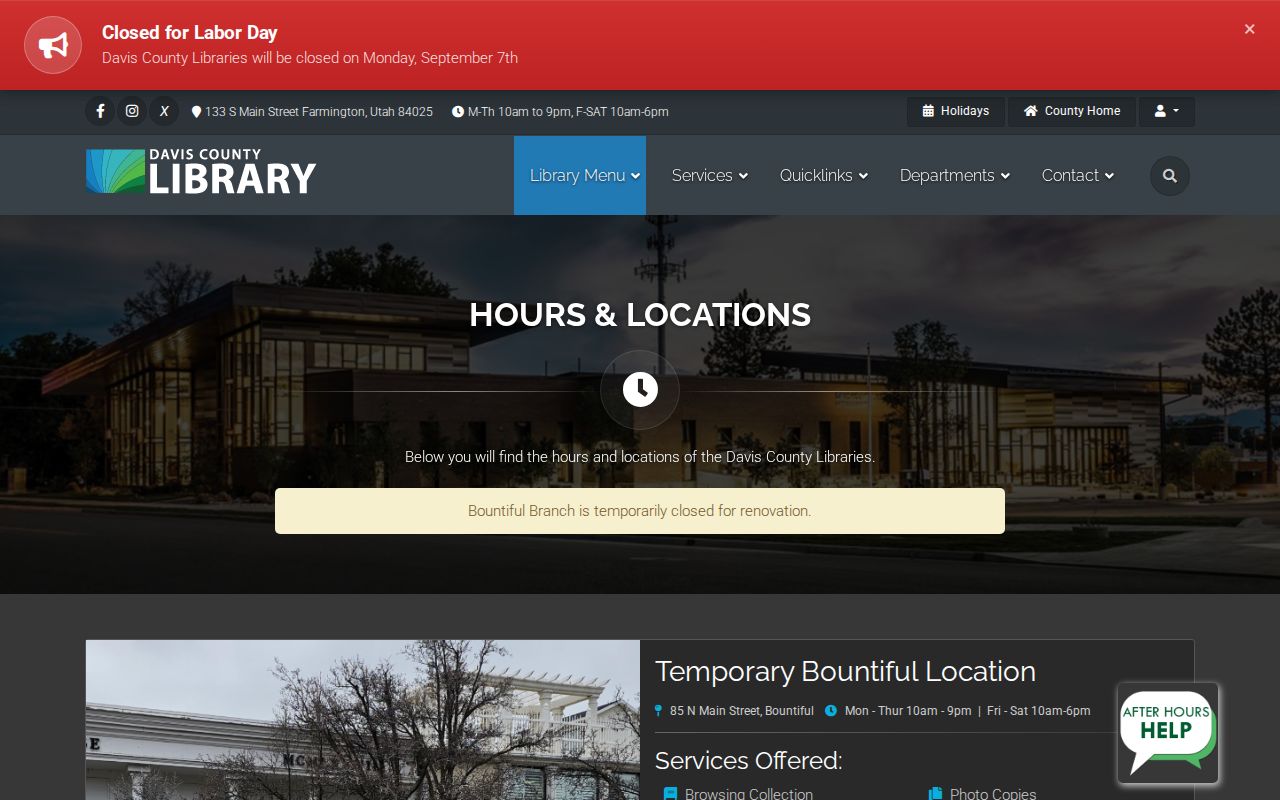
The Clearfield Branch at 1 North Main Street offers public computers, Wi-Fi, photocopying, interlibrary loan, study space, and a county property-locator GIS service. Its page does not list a dedicated local-history room, a complete Clearfield city-directory run, or a branch-specific obituary index. The system’s listed microfilm reader is at Farmington or the main library, so ask the branch or reference desk to confirm current holdings.
Clearfield City Directory and Census
Federal census pages released through 1950 are available under the 72-year rule at the current research date. Compare a directory entry with the nearest 1900, 1910, 1920, 1930, 1940, or 1950 census. Look at spouse, children, age, birthplace, occupation, ward, street, and neighboring households. The 1890 federal schedule is lost, so a household crossing that interval needs Davis marriage, land, church, newspaper, cemetery, and local register sources instead.
- Transcribe the directory year, page, name, address, phone, spouse, and printed abbreviations.
- Find the closest released census and compare household members, ages, birthplace, and street or ward.
- Search the Davis County Clipper for a move, marriage, death, court notice, or civic event between the two dates.
- Use the parcel map and Recorder index to separate occupant evidence from legal ownership.
- Close a death or heir trail with the death index, cemetery, probate, or estate deed where access permits.
A person disappearing from a city directory may have moved, died, changed a name, declined listing, or fallen outside the volume’s coverage. Only a dated second source can tell which explanation fits.
Clearfield City Directory to Modern Records
A historical city directory places a person in a year. To verify what happened later, carry the street address to the Davis County map and save the parcel ID and legal description. Search the Recorder for deeds and mortgages around the directory year, but remember that an occupant can differ from the owner. Use Utah Courts XChange for a filed-name case lead, Utah Archives or OVRS for vital records under the applicable access period, and the Clearfield Memorial Park route for burial information. The Clearfield street directory page covers the modern address chain in more detail.
The archive network is broad. Utah State Archives lists Clearfield City Recorder, Police, Finance, Justice, Parks and Recreation, and Public Works series. The University of Utah’s Utah City Directories collection can supply regional scans, while FamilySearch catalogs city, business, ward, death, and county-record materials. Verify Clearfield coverage item by item instead of describing a regional collection as a complete local run.
Trace a Clearfield City Directory Household
Start with either a surname or a known address and create a small research log. Write down the title, year, publisher if shown, page, exact spelling, address, phone, spouse, and any abbreviation. Search the same person in adjacent years, then search the address in the criss-cross section if one exists. Compare a directory year with the nearest census and with a newspaper date marker. Finally, use parcel and deed records to test whether the listed occupant owned the property or simply lived there.
This process also makes gaps visible. No official source located a complete year-by-year Clearfield reverse-directory run, a dedicated local-history shelf list, or a first and last printed year. Those are research gaps, not invitations to fill in a guessed publisher history. The verified 1967 item and the 1892 to 1992 newspaper span give the strongest local anchors.
Historical-use note. A directory entry is a dated source about a listed person or place. It is not a current resident confirmation, a complete household list, or a substitute for a certified record.